November 3, 1907
S. Wrenn
Interview with Harriet Scott Palmer
Lake Grove, Oswego, Oregon
Harriet takes a sip from her cup of tea and then begins to tell me about her trip along the Oregon Trail. "Altho I was but a girl of 11 years I distinctly remember many things connected with that far-off time when all of our western country was a wilderness... We were six months in crossing the plains in ox-wagons.

"In our home, in Illinois, in the early fifties, there was much talk and excitement over the news of the great gold discoveries in California -- and equally there was much talk concerning the wonderful fertile valleys of Oregon Territory -- an act of Congress giving to actual settlers 640 acres of land.
"My father, John Tucker Scott, with much of the pioneer spirit in his blood, became so interested that he decided to "Go West"....The spring of 1852 ushered in so many preparations, great work of all kinds. I remember relations coming to help sew, of tearful partings, little gifts of remembrances exchanged, the sale of the farm, the buying and breaking in of unruly oxen, the loud voices of the men, and the general confusion.
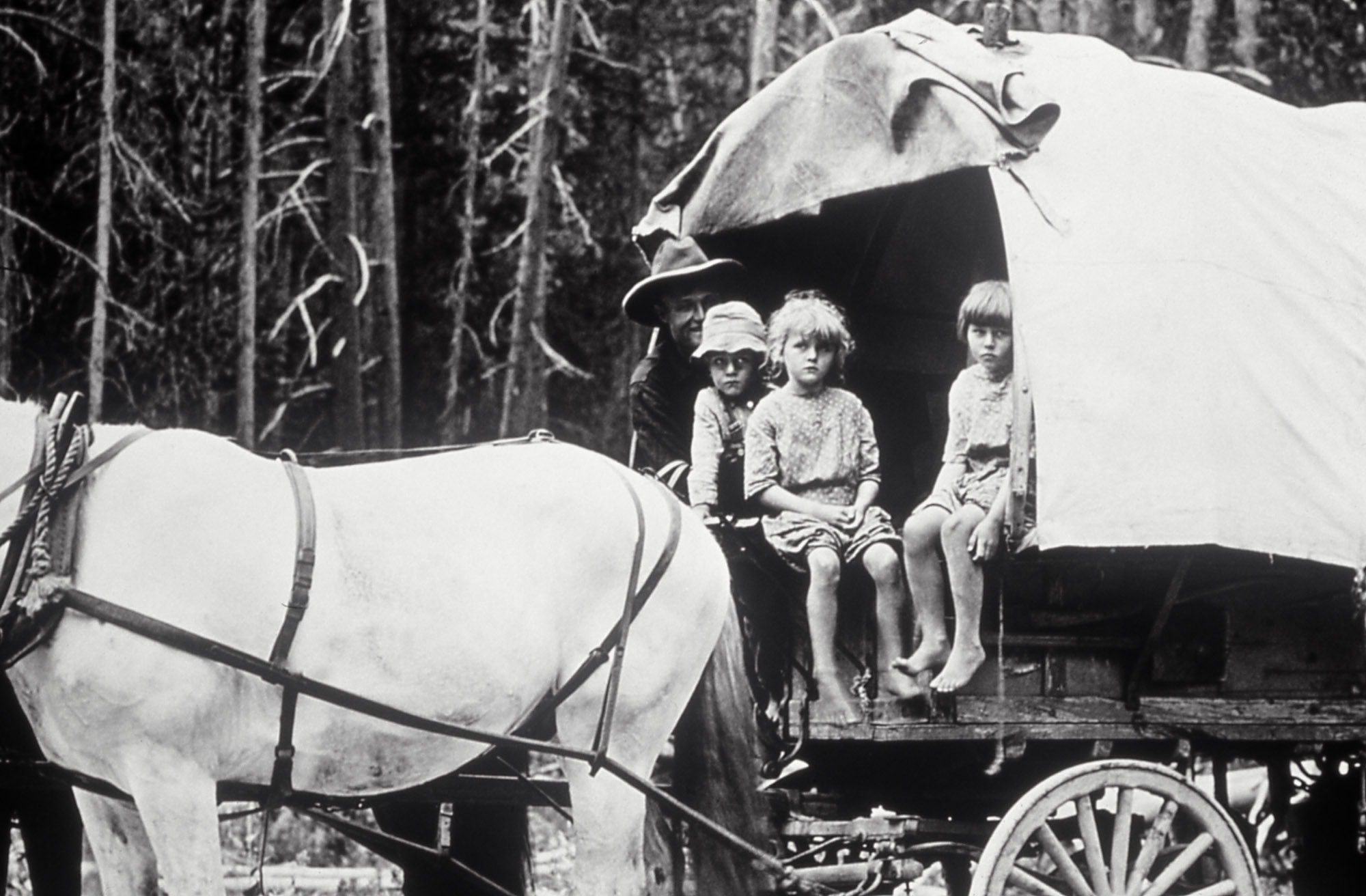
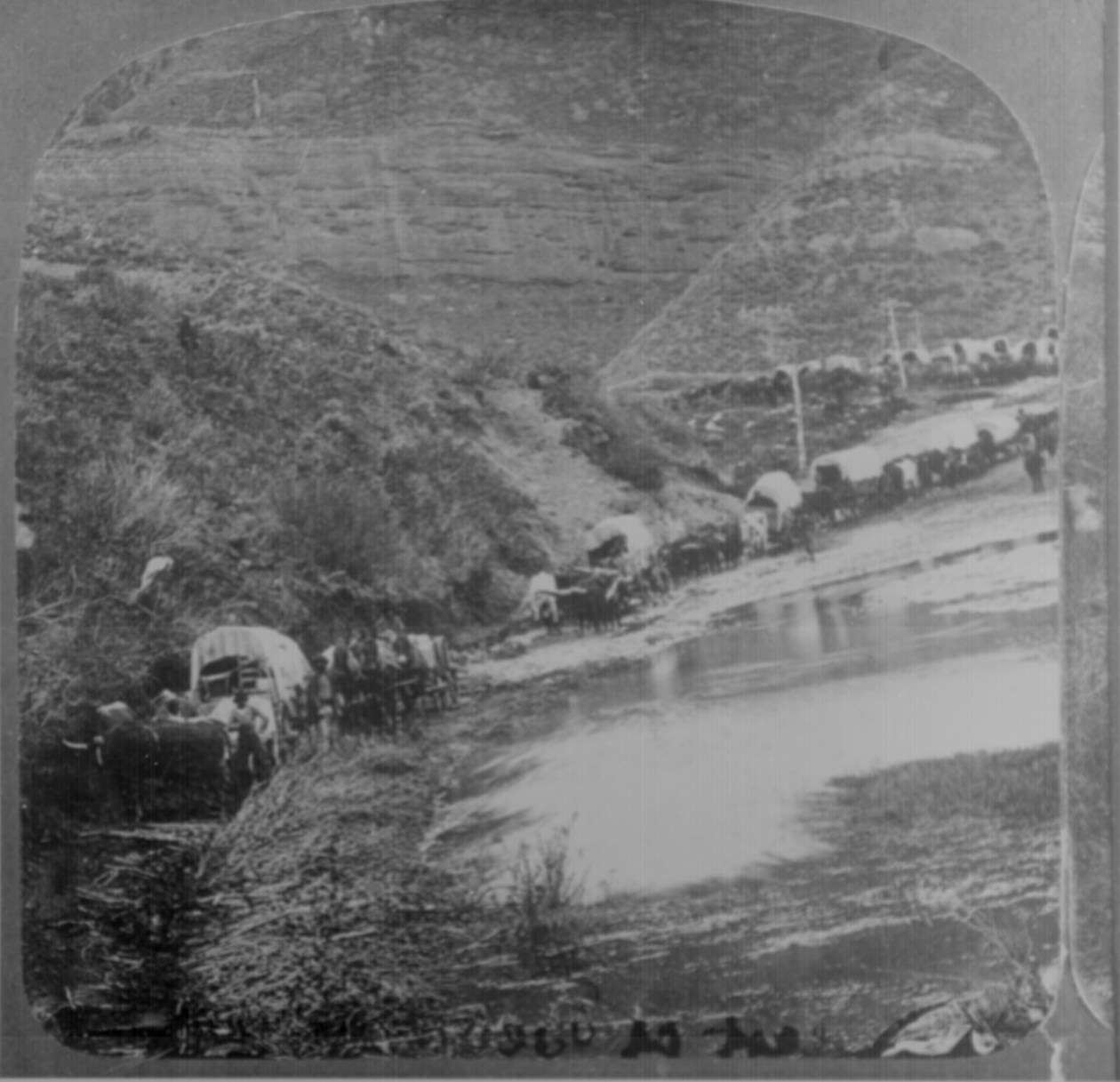
"The first of April came -- 1852. The long line of covered wagons, so clean and white, but oh so battered, torn and dirty afterward: The loud callings and hilarity: many came to see us off. We took a last look at our dear homestead as it faded from our view. We crossed the Illinois River on a ferry.
We looked back and saw our old watch dog (his name was Watch) howling on the distant shore. Father had driven him back, saying, 'Go back to Grandfather, Watch!' But he never ate afterwards, and soon died.
"We stopped at St, Joseph, Missouri, to get more provisions. We had never before seen Negroes, and all along this state we saw many negro huts, and went into one to see some little negro babies. My remembrance of the state was muddy roads, muddy water and a sort of general poverty.
"When we crossed into Nebraska, it seemed such a wide stretch of plain. We got our first sight of Indians -- a file of Indians were passing along, single file. They were the Pottowattamies, dressed in buckskins, beads, and leading their ponies. An open country was now before us. The melting snows had made the streams high, the roads nearly impassable. The Platte river, swift and swollen, didn't seem to have any banks. We had heard of the danger of quicksands. My father had, with the help of his drivers, raised the beds of his wagons, so as not to dip water ... When everything was in readiness all of us were tucked inside of the wagons. My father put me, last of all, inside the back end of the last wagon, told me to keep still and not be afraid. The loud voices of the drivers as they yelled and whipped up the oxen, the jogging of the wagons through the surging waters and over the quicksands, the memory is with me yet. When they got over the river, all were accounted for, but they couldn't find me. Finally I was pulled out from under the bows, nearly smothered. There were nine of us children, ranging from four years to my eldest sister, who was about nineteen."
"That would be your sister Abigail?" I asked.
She nodded and continued. "My mother kept the two youngest with her always in 'Mother's wagon'. Her health was not very good, and she had dreads and fears, but hoped she would live to get to Oregon. Fate willed it otherwise, and being frail and weary with the long journey, she fell a victim to the cholera, so prevalent that year on the plains, leaving her sorrowing family to grieve for her. When we reached Wyoming, there in the Black Hills, this side of Ft. Laramie, the passing of that dear, beloved mother was a crushing blow to all our hopes. We had to journey on, and leave her in a lonely grave -- a feather bed as a coffin, and the grave protected from the wolves by stones heaped upon it. The rolling hills were ablaze with beautiful wild roses -- it was the 20th of June, and we heaped and covered mother's grave with the roses so the cruel stones were hid from view. Her grave is lost. No one was ever able to find it again.
"The old emigrant trail hold many hard experiences. Coming to the Snake River and for many miles along, it was impossible to reach it to get water for the oxen. We had to travel all night at times. On one occasion... the camp was made after dark, and there was such a stench in the air. Early daylight found us camped close between two dead oxen, on one side, and a dead horse on the other -- so we had to move before breakfast.
"About two miles above the great American Falls we were able to get the cattle down to drink. It so happened that after the yokes of the oxen were removed and the oxen driven into the water, an old headstrong bull plunged into the river and swam across, the rest of the cattle following, except two cows that our man were able to keep back. Our company was in great peril.
 "My father, generally equal to any emergency, decided that any one or more of the men who were good swimmers, should go above our camp, swim over and drive the cattle back. This was attempted by two young men, one of whom swum over first, on one of our mares; the other was drowned, and as we with agonized eyes watched the stream we saw the white face of our old mare "Sukey" bobbing up and down in the boiling waters. She was such a loved old mare that we could not bear to leave her at home in Illinois. A third man tried and got safely over. We could see his naked form over the river among the hot burning rooks. It was impossible for him alone to drive the cattle back. My father made a mighty effort to get across. Then he ordered the calking of one of the wagon beds to make a boat, and in this, three more paddled over and took some clothing to cover the poor sunburnt men on the rooks -- he was over there in that awful predicament for three days; his skin all peeled off, and he nearly lost his mind from his awful experience. They got the cattle safely over the river again, but the two cows that stayed behind ate of something poisonous and died during the night.
"On and on we journeyed -- averaging 15 miles a day over cactus, sagebrush, hot sand. Everybody's shoes gave out and we bartered with Indians for moccasins, but that didn't help much about the prickly pears. One by one the oxen fell by the way. We came to Burnt River -- a most desolate country. Here our baby brother Willie fell sick. It was in the heat of August. The train was halted, that the darling child of 4 years could be better cared for, but he became unconscious and passed away. The soil here was thin and full of rocks. My poor father, broken-hearted, had the men cut a cavity out of the solid rock jutting out of Burnt River Mountain, and here the little form was sealed beside where the only living thing was --- a little juniper tree. My brother Harvey found it, twenty years later, and he peeled some of the bark off of the juniper tree and brought it back to my father. My father had carved Willie's name on the tree.
"August passed. We were nearing the Cascade Mountains. The oxen were worn out, and the wagons were in poor condition to cross' the mountains. Some wagons had to be left; some of the oxen were poisoned eating mountain laurel. Our provisions were exhausted by this time, and for three days we had only salal berries and some soup made by thickening water, from flour shaken from a remaining flour sack, My uncle Levi Coffee, who was a great joker, looked at the poor mess and said to his wife, 'Why Ellen, ain't there a little bread or something.' 'Oh no,' she said, "we are all starving together.'
"It so happened a man overtook us on horseback, and father bought some of the flour he had in a sack behind his saddle. He paid $1.00 a pound. It proved to be bitter with mildew and unfit to eat. My sister, having charge of the two smaller children, and my aunt, whose youngest was seven, saved and hid in their pockets same biscuits they from time to time, doled out to the three littlest children.
We came to the old Barlow Road, and a station called Barlow's Gate, in the Cascade Mountains, where we found provisions, and actually some fruit -- apples and peaches and plenty of bread. It was not long now till we reached the valley settlements and found relatives who had came the year before.
"Before we reached Oregon City, my father was fortunate enough to buy two pounds of butter. The hungry crowd was so great that before we smaller ones had our turn at the improvised table, the butter had all been eaten up. There were six of us smaller children who did not get a taste of butter, and the thought of that rankled in us for years.
 "It was my duty to keep up the loose stock in crossing the plains, and I was given charge of an old sorrel mare who had one eye. Her name was Shuttleback on account of the shape of her back. One day we had traveled long in the heat and both Shuttleback and I needed water. I was about a mile behind the train, and off at the side of the road a grove of willows was growing. It looked like water might be there. There was, a little tributary of the Snake River, so I gladly got off the saddle that had no horn on it, and first let the mare drink. It was a steep place. The mare began to plunge and I soon saw she was in quicksand. I held on tightly to her rein, yelled with all my might, knowing there was a man behind me also driving stock. He heard me and rushed to my assistance, telling me to hold on, and not be afraid, he would bring help. He rushed ahead and brought back my father and three other man, and with ropes and a long pole pried her out of the quicksand and floated her down the stream where she finally landed on her feet. I fully expected punishment, but my father just picked me up, sat me down on the wet, muddy saddle, slapped the mare and said, 'Now, go on!'
 "Then we reached Laurel Hill, in the Cascade mountains. Oh that steep road! I know it was fully a mile long. We had to chain the wagon wheels and slide the wagons
down the rutty, rocky road. My Aunt Martha lost one of her remaining shoes, it rolled down the mountainside. I can hear her now as she called out in her despair, 'Oh, me shoe, me shoe!" How can I ever get along?' So she wore one shoe and one moccasin the rest of the journey.
"When we came to Ft. Walla Walla, we saw a crowing rooster on a rail fence. Oh, how we all cried... There we stood, a travel-worn, weary, heart and homesick group, crying over a rooster crowing."
Adapted from:
- Palmer, Harriet Scott. "Crossing the Oregon Trail" American Memory. Library of Congress.
Learn more about the Oregon Trail:
- U.S. Department of the Interior. "Basic Facts about the Oregon Trail."
- National Park Service. "Oregon History and Culture."
Photo Credits:
- Children in wagon. National Park Service. Date unknown.
- C. W. Carter. Wagon caravan. National Archives. c. 1870.
- Wagon people. Oregon Department of Transportation. Date unknown



No comments:
Post a Comment